Your health, finally in your hands.
NephroLife helps haemodialysis patients track sessions, understand blood reports, manage diet, and share health summaries with their doctor.
Built for every part of haemodialysis life
From your session on Monday to your blood report on Friday — NephroLife tracks it all, simply.
Sessions, with live guidance
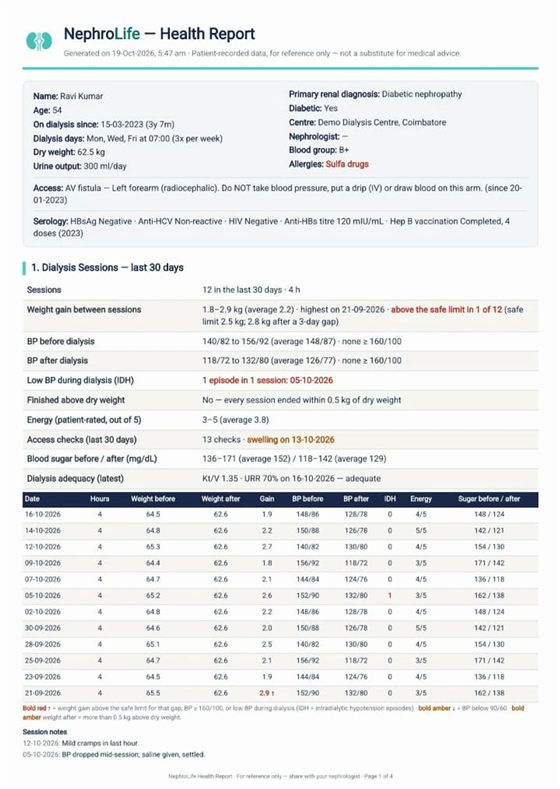
Log BP, weight, fluid removed, energy and injections. As you type, see your weight gain against your safe limit, how much to remove to reach dry weight, the fluid removal rate, and dialysis time worked out from the start and finish.
Lab reports, explained
Snap a photo or upload a PDF and the values are read for you. Tap any value to see its target and what it means in plain words. A dangerous result, such as very high potassium, brings an urgent message to contact your dialysis unit.
Trends & AI insights
Hb, ferritin, potassium, phosphorus and more, charted over 3, 6 and 12 months. With Pro, AI reads your labs, diet and trends together, explains what is changing and suggests what to ask your nephrologist.
Daily meal plan
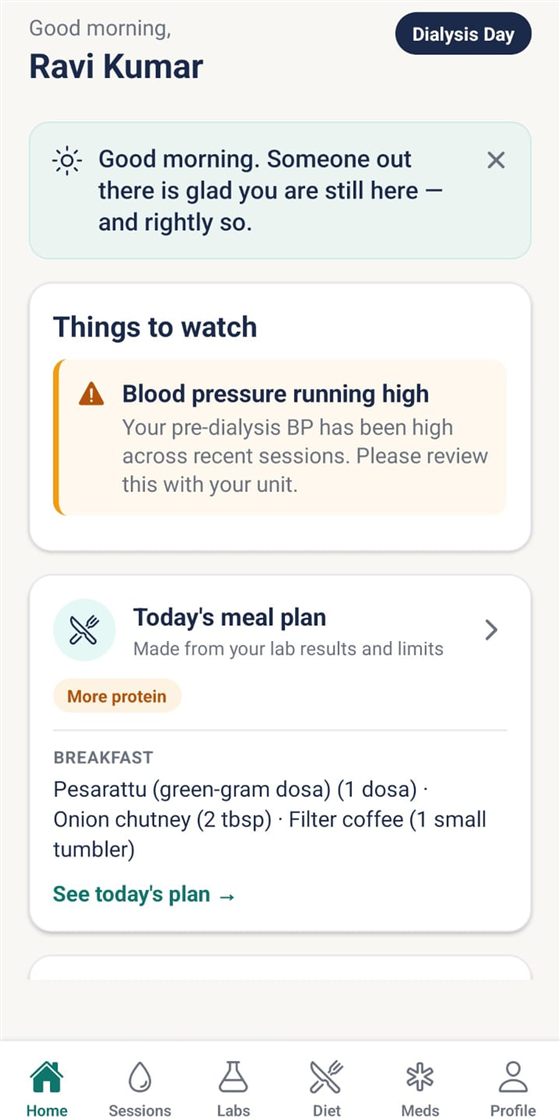
A full day of everyday Indian meals built from your latest potassium, phosphorus, calcium and sodium results, within your fluid allowance and aiming for your protein goal — free. With Pro, AI can plan the day instead: it picks only from the app's food list, and the app checks every dish against your limits before you see it.
Food guide & tracking
528 foods from IFCT 2017 plus 300+ cooked dishes from across India. Each is judged for your own lab results and the portion you eat, and your day's potassium, phosphorus, sodium and fluid add up as you log. With Pro, ask the AI diet assistant — “Can I eat banana today?”
Medicine & test reminders
Reminders for every medicine, including post-dialysis doses. When a blood test or serology is due by guideline intervals, Home shows it and your dialysis-day reminder names it, so it can be drawn at that session.
Symptoms & “What helps”
Log cramps, dizziness, itching, swelling and more. “What helps” guides for low BP, cramps and swelling use your own numbers, and serious symptoms like chest pain tell you clearly when to get help. Your nephrologist decides any treatment.
Doctor PDF Report
Generate a complete health summary PDF — sessions, labs, trends, medications — and WhatsApp it to your nephrologist.
Easy from day one
A “New to dialysis” guide to fluid, food, fistula care, daily life and when to get help. Large and extra-large text for older eyes. Your BMI, and how your protein goal is worked out. All in Tamil and English.
Emergency card
Show or send this if you are taken to a hospital. It tells the staff you are on dialysis, which arm to protect, your allergies and medicines, and whom to call.
Works with no signal
Dialysis units often have poor signal. The sessions, labs, medicines, symptoms and food you log are saved on your phone first and sent when the connection returns.
Hospital events
Record events such as a hospital admission, and your linked doctor can see them.
What changes for you
- Understand your own numbers. Tap any lab value for its target and a plain Tamil or English explanation — no medical jargon.
- Eat with confidence. A daily meal plan built from your own potassium, phosphorus, calcium and sodium — not a generic chart.
- Know what helps. Simple guides for low BP, cramps and swelling, with your own numbers — and clear advice on when to call your unit.
- Never miss a dose or a test. Medicine reminders, plus your dialysis-day reminder names any blood test or serology that is due.
- Catch problems earlier. Trends, symptom logs and urgent alerts for dangerous lab results reveal problems between visits, before they become serious.
- Walk in prepared. One tap makes a complete PDF summary to share with your nephrologist.
- Free to start, works offline. Core tracking is free forever, in Tamil and English, with large text if you need it.
Finally know what
you can eat.
528 foods from the Indian Food Composition Tables 2017, plus 300+ cooked Indian dishes — including 89 regional dishes worked out ingredient by ingredient from IFCT recipes. Judged against your own blood results, not a generic chart.
-
1
Your latest resultsPotassium, phosphorus and calcium from your last blood report set how strict the check is.
-
2
The portion you eatThe check uses the amount you actually eat — two idlis, not a fixed 100 g.
-
3
Your day so farWhat you log adds up against your daily potassium, phosphorus, sodium and fluid allowance.
So there is no fixed “safe” or “avoid” list: the same dish can suit one patient and be too much for another. Star fruit is the one exception — it is always marked avoid.
* General information, not medical advice. Each food is judged from your latest lab report and portion against general thresholds — always follow your nephrologist and dietitian. Nutrient data: Indian Food Composition Tables 2017 (IFCT), ICMR–National Institute of Nutrition; cooked dishes are worked out from IFCT ingredients.
Get NephroLife free
Core tracking is free forever. Get the Android app on Google Play.
Needs Android 7.0 or newer. An iPhone version is planned.